The Overland Journey to Sneffels
A Journey to the Centre of the EarthThe Overland Journey to Sneffels carries Professor Hardwigg, Henry Lawson, and Hans Bjelke from Reykjavik toward the foot of Sneffels, converting the expedition’s geological ambition into a sustained passage through Iceland’s difficult terrain. Along the way, the travelers depend on local hospitality, horses, ferries, and Hans’s knowledge; the contrast between Hardwigg’s impatient purpose and the guide’s practical composure shapes the journey as much as the landscape does.
Guide, agreement, and route
Hans Bjelke joins the expedition through the recommendation of M. Fridriksson. Henry describes him as grave, silent, and phlegmatic—a marked contrast to his impulsive uncle. Their temperaments differ, but the practical arrangement is quickly made: neither man is preoccupied with bargaining, and Hans agrees to guide the party to Stapi, on the southern slope of the Sneffels peninsula, at the volcano’s foot.
The first estimate of the distance is misleading. Hans says the journey is about twenty-two miles, a figure Professor Hardwigg initially supposes can be covered in two days. Once he learns that Hans means Danish miles of eight thousand yards each, and takes account of the appalling roads, he revises his estimate to eight or ten days. The correction establishes a pattern: the professor may set the expedition’s purpose, but the actual pace and practicable route belong to the terrain and the guide who knows it.
Four horses are prepared, two for baggage and two for Professor Hardwigg and Henry. Hans refuses to ride, saying that nothing will make him climb onto an animal; he knows every inch of this coast and promises to take the shortest way. His service is not limited to reaching Stapi: he is to remain for the duration of the professor’s scientific investigations at three rix-dollars a week, payable every Saturday night, with the agreement ending if payment is missed. When Hardwigg offers an advance, Hans refuses with a single emphatic word. His terse speech and precise terms make him a guide defined by practical certainty rather than display.
From Reykjavik to Gardar
The departure begins in Reykjavik, where the expedition’s foreignness is already apparent. On arrival in Iceland, Professor Hardwigg presents letters from Copenhagen to the governor, Baron Trampe, and speaks with him in Danish, a conversation Henry cannot follow. The governor places himself at the professor’s disposal. The travelers are then received by the mayor, M. Finsen, and find a crucial intermediary in M. Fridriksson, the college’s professor of natural science, whose Latin allows him and Henry to understand one another. Fridriksson’s recommendation brings Hans into the party, linking the expedition’s scientific contacts in town to its practical passage across the peninsula.
Henry’s view of Reykjavik provides a human-scaled contrast to his uncle’s priorities. The town lies on a flat, marshy plain between two hills, beside lava terraces and the bay of Faxa; Sneffels’s glacier bounds the bay to the north. Its longest street runs along the shore past red-painted wooden huts, while another leads west toward a small lake and the residences of the bishop and other non-commercial figures. Henry finds the streets dismal and quickly feels he has seen enough. Professor Hardwigg, by contrast, says he has little interest in what lies above the surface: what matters to him is what is below. The overland route thus begins with a difference in attention—the narrator registers the inhabited landscape, while the professor is already looking through it toward the volcano and the subterranean project.
At Aoalkirkja, a small settlement of only a few houses, Hans pauses for half an hour, shares the travelers’ frugal breakfast, and answers the professor’s questions about the road with his customary economy. Asked where they will spend the night, he says only, “Gardar!” Henry checks the map and finds a Gardar near Hvalfjord, about four miles from Reykjavik; his uncle reacts with an energetic grimace. The episode makes the gap between map-based expectation and the guide’s route tangible. Hans’s one-word answer supplies a destination, but not an explanation, and the travelers must adjust their assumptions to the journey as he conducts it.
The fjord crossing requires patience rather than speed. Henry understands that they must wait until the sea reaches slack water at high tide, when neither ebb nor flow threatens to carry the ferry out or drive it against the rocky coast. The favorable moment does not arrive until six in the evening. Professor Hardwigg, Henry, Hans, two boatmen, and all four horses then crowd into an awkward flat-bottomed boat. Henry, accustomed to the steam ferries of the Elbe, finds the boatmen’s long oars a poor means of travel. The crossing takes more than an hour but ends without accident; half an hour later, the party reaches Gardar.
Inland passage and local hospitality
The morning after their stay at Gardar, the travelers take leave of their hosts. Professor Hardwigg has difficulty persuading the hospitable peasants to accept proper payment, a small reversal of Hans’s insistence on receiving his own wages on schedule. The journey proceeds through exchanges that do not follow a single rule: Hans’s work has exact contractual terms, while the households that shelter the party offer hospitality reluctantly compensated.
A hundred yards beyond Gardar, the country changes. The ground becomes marshy and boggy; streams and rivulets repeatedly require fording, and the baggage must be kept dry. A mountain range extends beside the route like a natural fortification. The landscape grows more deserted, though Henry occasionally sees people in the distance. He describes the sight of badly afflicted inhabitants in terms that expose his revulsion, while noting that they run away rather than approach the travelers to beg. The passage is therefore not an empty wilderness in any simple sense: human presence remains, but appears at a distance, filtered through the outsider’s unsettled gaze.
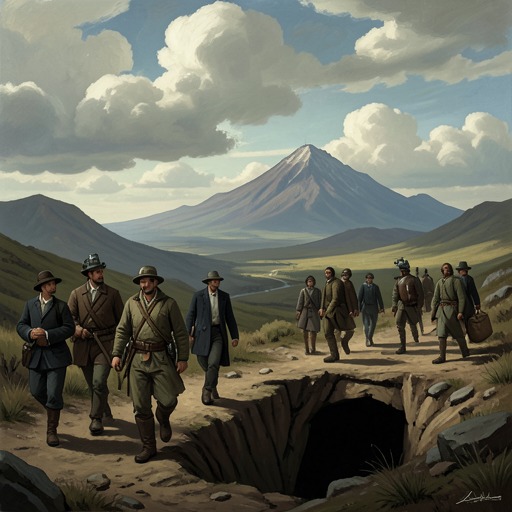
The route continues through soft ground and past frequent small lakes, curving west around the great bay of Faxa. The white twin summits of Sneffels rise into the clouds less than five miles away. As the country opens toward the volcano, the horses move more quickly and the obstacles cease to check them. Henry is already suffering from fatigue, but Professor Hardwigg and Hans seem to treat the rugged journey as little more than a walk. Their different responses sharpen the contrast between the narrator’s bodily limits and the two men’s apparently unshaken forward motion.
The Saturday stages and arrival at Stapi
On Saturday, 20 June, at six in the evening, the party reaches Budir, a small town picturesquely placed on the ocean shore. Hans asks for his wages, and Professor Hardwigg settles with him at once, honoring the agreement’s Saturday deadline. The household that receives the travelers is Hans’s own extended family—his uncles and cousins—who offer them hospitality. Henry would gladly rest after the journey, but his uncle has no desire to stop; although the following day is Sunday, Henry must mount his horse again.
The next stage brings the travelers along the enormous base of Sneffels, where granite projects from the earth and the mountain’s proximity again alters the ground beneath them. Professor Hardwigg never takes his eyes from the volcano. He gestures toward it and looks at it with what Henry reads as sullen defiance, as if the mountain were an adversary he has resolved to conquer. The route has carried the expedition from a distant object on Reykjavik’s horizon to a looming obstacle that commands the professor’s attention.
After four hours of steady travel, the horses stop of their own accord at the door of the presbytery of Stapi. The arrival fulfils Hans’s original agreement and brings the overland leg to its destination: the village lies at the foot of the volcano the expedition intends to investigate. The account gives the journey a precise material rhythm—distances recalculated, a tide awaited, wages paid, shelter accepted, horses driven on—before the scientific descent can begin.
Journey as expedition and act of seeing
The overland passage is more than connective travel. It establishes the division of labor on which the expedition depends: Professor Hardwigg supplies the governing objective, Henry records the landscape and its effects on him, and Hans supplies local knowledge that turns an ambitious itinerary into a feasible route. The professor’s willingness to press on despite Henry’s fatigue is set against the guide’s measured competence, visible in his choice of the shortest way, refusal to ride, and punctual wage arrangement.
The route also places competing ways of knowing side by side. Henry consults a map to locate Gardar; Hans names the night’s destination without elaboration and leads the party through roads, marshes, and crossings that cannot be reduced to the map’s first impression. Professor Hardwigg’s concern with what lies beneath Iceland gives the journey a scientific destination, yet its progress depends on the visible and immediate: the state of the tide, the quality of the ground, the animals’ pace, and the people who provide lodging. By the time Sneffels fills the travelers’ view and the horses reach Stapi, the expedition has been brought to the volcano not by ambition alone, but by a succession of practical judgments and negotiated local arrangements.